


Vetta
Vetta Spillmann Gilt Chronograph V71
Vetta Spillmann Gilt Chronograph V71
Year: 1942
Couldn't load pickup availability
CHAT ON WHATSAPP
The 1940s represent one of the most fascinating periods in the history of mechanical chronographs. At a time when wristwatches were evolving into increasingly sophisticated precision instruments, manufacturers combined substantial movements, carefully engineered cases and elaborate dial-making techniques. This Vetta chronograph, powered by the distinguished Valjoux 71 caliber, embodies that balance between technical purpose and classical elegance.
Its 37.5 mm stainless steel case, manufactured by Spillmann, offers generous proportions for a watch of its era. The inverted pump pushers are a particularly distinctive feature, giving the case a recognisable profile while reflecting the experimentation in chronograph case design that characterised the period. Today, the combination of a substantial steel case, three-register architecture and refined dial design makes this type of watch especially appealing to collectors interested in the formative years of modern chronography.
At the heart of this Vetta lies the Valjoux 71, a manual-winding chronograph movement from one of the most respected families of Swiss mechanical calibers. Its three-register configuration provides running seconds, an elapsed-minutes counter and an hour counter, allowing the wearer to measure longer intervals with greater practicality than a conventional two-register layout. The movement belongs to a generation of chronographs in which mechanical complexity was central to the watch's purpose, long before electronic timing instruments transformed professional timekeeping.
During the 1940s, chronographs served applications ranging from sport and motoring to industrial measurement and aviation. The ability to record elapsed time was essential in many technical fields, and the wrist chronograph became an increasingly important personal instrument. Although this broader history provides context for the Vetta, an aviation or military provenance for an individual example should only be claimed when supported by specific documentation.
The Valjoux 71 is particularly interesting because it represents the traditional mechanical approach to chronograph construction: a movement designed around a dedicated timing mechanism, with an architecture that rewards appreciation beyond the dial itself.
The dial is the defining aesthetic feature of this Vetta. Its gilt finish, gold-coloured Roman numerals and three-register layout create a striking contrast between classical elegance and technical functionality. The term gilt describes the appearance of metallic details against a contrasting background, traditionally achieved through a process in which the dial's underlying metal contributes to the final colour of the lettering and graphics.
In a classic glossy gilt construction, a brass dial plate is carefully prepared and polished. Selected areas are protected using a resist applied in negative, preserving the metallic surface where the numerals, lettering and other details are intended to appear. A dark coating, often deposited through a galvanic process, covers the remaining areas. Once the protective resist is removed, the exposed metal produces the characteristic golden graphics against the dark dial.
A transparent protective lacquer can then create the deep, reflective surface associated with many vintage gilt dials. The final appearance depends on several variables, including the preparation of the metal, the resist pattern, the coating process and the finishing stages. This is a different manufacturing approach from simply printing gold-coloured ink onto a finished black surface. The metallic details have a distinctive relationship with the underlying dial plate, producing subtle changes in tone as light moves across the surface.
The Arabic numerals add further character. Their classical typography contrasts with the functional arrangement of the three counters, giving the dial a distinctive visual identity that is more formal than that of many instrument-style chronographs. It is precisely this combination of elegant graphics and mechanical purpose that makes certain 1940s chronographs so compelling.
Vetta occupies an interesting place in the history of Italian watch collecting. The name is associated with the wider heritage of Wyler Vetta, a story connecting Swiss watchmaking expertise with the Italian market. The Binda organisation played an important role in the distribution of Wyler watches in Italy during the early twentieth century, helping establish the brand's presence among Italian consumers. The broader Wyler Vetta identity became associated with reliability, technical innovation and watches intended to accompany active lifestyles.
This historical context is relevant to understanding the appeal of a Vetta chronograph. The brand belongs to a period when Swiss mechanical expertise and Italian commercial culture helped shape the market for precision wristwatches. Sport, motoring and aviation all contributed to the wider public interest in reliable timekeeping instruments, while chronographs offered a particularly practical combination of functionality and mechanical sophistication.
It is important, however, to distinguish the general history of the brand from the documented history of a particular watch. The Vetta name and the Valjoux 71 movement provide meaningful historical context, but they do not by themselves establish military issue, professional aviation use or another specific provenance.
One of the enduring attractions of watches from this period is the attention given to the relationship between movement, case and dial. Quality was not simply a matter of the calibre fitted inside the watch. Case proportions, pusher construction, dial finishing, typography and the legibility of the counters all contributed to the final result.
This Vetta brings those elements together particularly well: a substantial 37.5 mm stainless steel case by Spillmann, distinctive inverted pump pushers, the three-register Valjoux 71 and a gilt dial featuring Roman numerals.
The finishing of the dial is especially important in a collector's assessment. Originality, consistency of the graphics and the relationship between the surface and its metallic details can have a considerable impact on the character of a vintage chronograph. Similarly, the case should be assessed for its original proportions and the preservation of its defining geometry rather than judged solely by superficial brightness.
The period also reminds us that mechanical watches were manufactured to serve practical purposes while remaining objects of design. The finest chronographs of 1942 combine precision engineering with a degree of visual individuality that is difficult to separate from their historical appeal.
This Vetta is an appealing representation of that philosophy. Its three-register architecture provides the technical foundation, while the Spillmann steel case and inverted pump pushers give it a strong physical presence. The gilt dial, with its Roman numerals and gold-toned graphics, introduces an elegant dimension that distinguishes it from more overtly utilitarian chronographs.
Completed with a black matte Louisiana alligator leather strap, it benefits from a restrained combination of materials and colours that complements the period design without overwhelming it.
For collectors, the appeal of a chronograph like this lies in the complete composition: movement architecture, case construction, dial technology and proportions working together as a coherent historical object. It belongs to an era when mechanical chronographs were sophisticated instruments in their own right, and when the details of their construction rewarded close examination.
A Vetta Valjoux 71 is therefore more than an exercise in vintage styling. It offers a tangible connection to the technical ambition, manufacturing skill and design culture of 1940s Swiss watchmaking.
Are your watches authentic?
Are your watches authentic?
Yes. Before it goes on sale, every watch is checked by our team: authentication, inspection of the movement, case and bracelet, and documentation of its condition. We guarantee the originality of all our pieces.
Is there a warranty?
Is there a warranty?
Every purchase is covered by the legal guarantee of conformity under Italian and EU law. Any lack of conformity must be reported within two months of discovering it.
How is the watch shipped?
How is the watch shipped?
Shipping is free worldwide. We use selected couriers and send you the tracking details once payment has been received. For deliveries outside Italy, import duties and taxes are paid by the buyer.
How can I pay?
How can I pay?
By credit card, bank transfer or buy-now-pay-later services where available. If you pay by bank transfer you get a 1.5% discount: contact us on WhatsApp.
Can I see the watch in person?
Can I see the watch in person?
Yes, in our shop at Via Porta Rossa 75/R in Florence, usually open from Tuesday to Saturday. Opening hours change with the season: you always find the current ones on Google Maps.
Legal guarantee of conformity
Download the notice as PDF


Specifics
-
General info
- Serial number: 27xx
- Case material: Steel
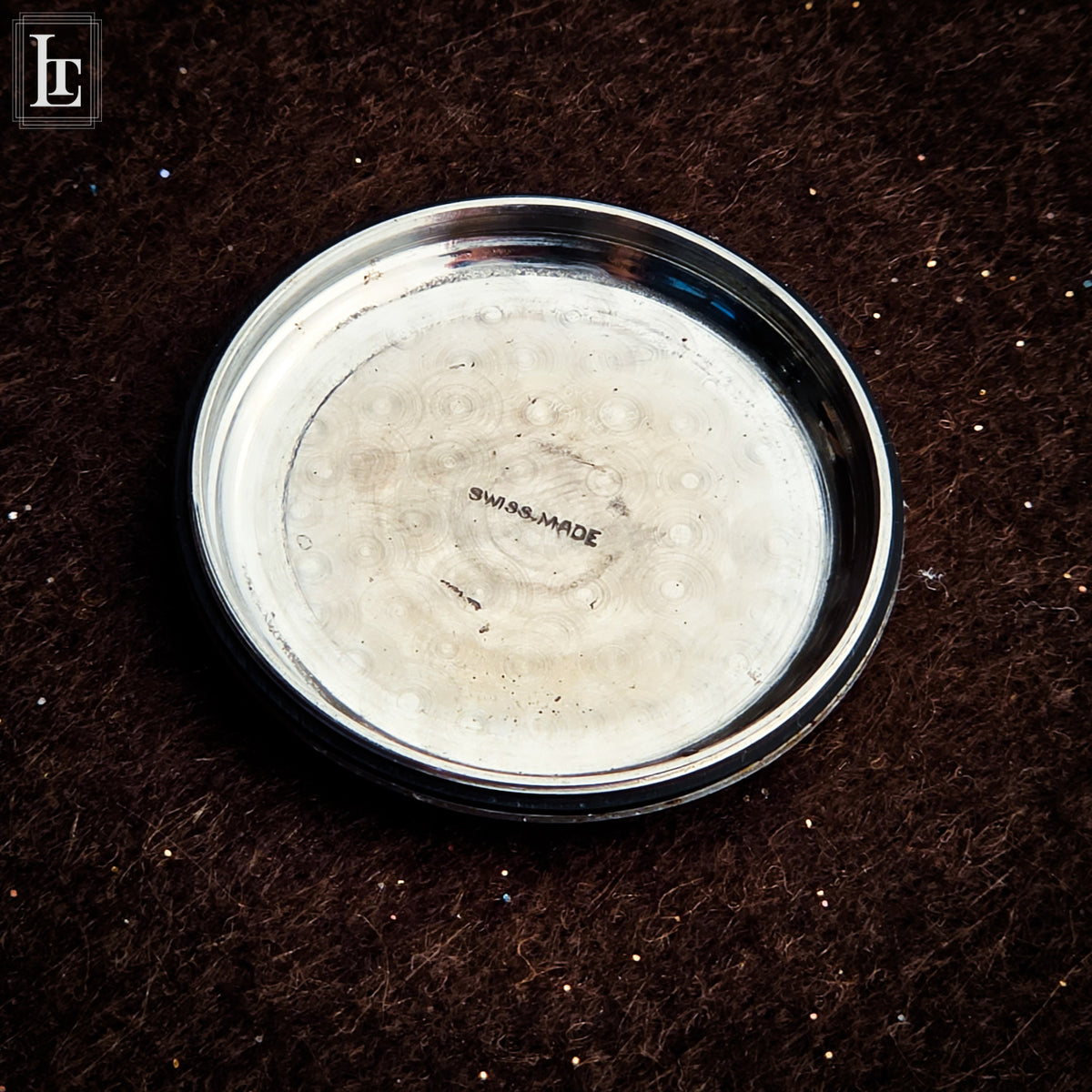
- Caseback: Screw-back
- Case diameter: 37.5 mm
- Glass: Plexiglass
- Bezel Materials: Steel
- Dial color: Black
- Dial numerals: Arabic
- General conditions: Great conditions
- Water resistance rate: Not waterproof
- Delivery contents: Watch only
-
Band or Strap
- Band material: Leather
- Lug width: 20 mm
- Buckle type: Classic
- Buckle material: Steel
-
Movement
- Calibre: Valjoux 71
- Movement type: Manual wind
- Complications: Chronograph
- Service: Recently serviced or New