

Eska
Eska Art Déco steel
Eska Art Déco steel
NOT AVAILABLE
Brand: EskaTypology: Vintage dresswatch
Year: 1940
Founded in 1918 by Silvan Kocher Sr. and his son Erwin, Eska was born in Selzach, in the German-speaking part of Switzerland. Their workshop, S. Kocher & Co., embodied the pragmatic yet refined Swiss approach to watchmaking: solid mechanics, restrained aesthetics, and absolute focus on function.
Art Déco, the dominant artistic language of the 1920s and 1930s, was defined by geometry, symmetry, and ornamental precision. What makes Art Déco historically relevant is its reach: it was the first truly democratized design movement, influencing architecture, objects, and everyday life. Watches were no exception.
This Eska is a textbook example of Art Déco applied to horology. The square case, clean lines, and balanced proportions are pure period language. The standout element is the barrel-shaped plexiglass crystal, curved and worked to follow the geometry of the case rather than flatten it. This detail alone places the watch firmly in the 1940s and gives it depth, light play, and unmistakable character.
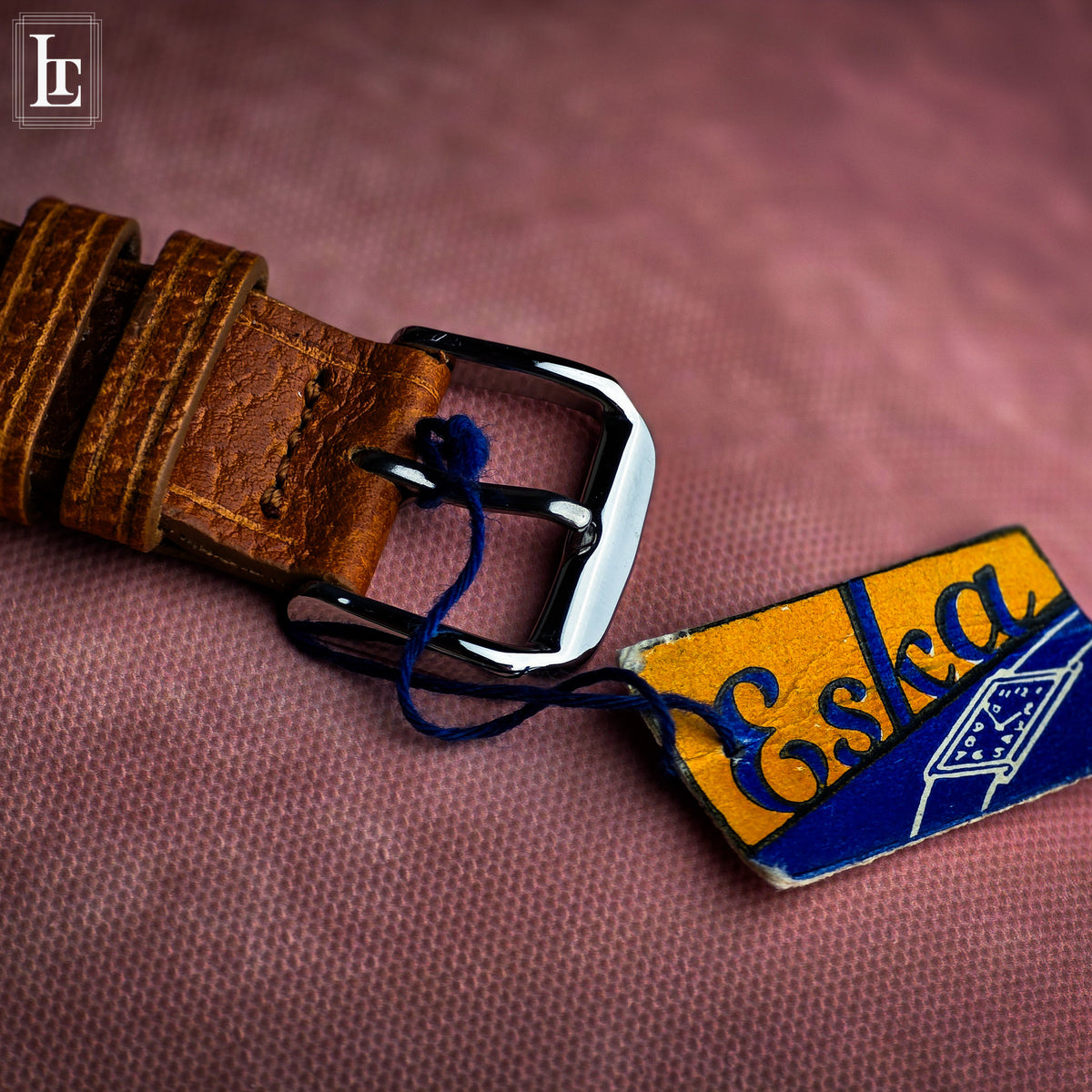
The stainless steel case houses an in-house Eska hand-wound movement—simple, honest, and mechanically coherent with the era. This is a new old stock piece: never worn, untouched, and preserved in exceptional condition from the 1940s to today. It is delivered with a brown leather strap and its original cardboard tag.
Finding watches of this type, genuinely new from this period, is becoming increasingly unrealistic. That scarcity is precisely why pieces like this continue to fascinate us at LTF.
Legal guarantee of conformity
Download the notice as PDF


Specifics
-
General info
- Serial number: 9316
- Case material: Steel
- Glass: Plexiglass
- Caseback: Snap-back
- Case diameter: 28.0 mm
- Dial color: Silver
- Dial numerals: Arabic
- General conditions: New Old Stock
- Water resistance rate: Not waterproof
- Delivery contents: Watch only
-
Band or Strap
- Band material: Leather
- Lug width: 16 mm
- Buckle type: Classic
- Buckle material: Steel
-
Movement
- Movement type: Manual wind
- Complications: None
Available now
-
Franck Muller Long Island Lady quartz
Regular price €3.000,00Regular priceUnit price per -
Jaeger LeCoultre Reverso GT two-tone Full Set
Regular price €6.800,00Regular priceUnit price per -
Vetta Gilt Chronograph V23
Regular price €5.800,00Regular priceUnit price per -
Vetta Spillmann Gilt Chronograph V22
Regular price €7.800,00Regular priceUnit price per