


Rolex
Rolex Submariner 1680 red writing MK5
Rolex Submariner 1680 red writing MK5
Reference: 1680
Year: 1972
Our guarantees
-
Guaranteed authenticity
Authentic, period-correct components
-
Lab checked
Technical inspection before sale
-
Insured DHL Express
International shipping
-
12-month warranty
Commercial warranty on working order
Do you want to pay with bank deposit? Contact us and get a 1.5% discount on your order!
Write to us on WhatsAppThe Rolex Submariner Date Ref. 1680 “Single Red” MK5, circa 1972, occupies a fundamental position in the history of vintage Rolex collecting. Few watches embody the transition from professional diving instrument to internationally recognised horological icon quite as convincingly. Introduced in the late 1960s, the reference 1680 was the first Submariner to incorporate a date complication, establishing an entirely new branch of the collection. Yet among all the variations produced during its lifetime, one particular configuration has become an object of enduring fascination: the legendary Red Submariner, distinguished by the model name printed in vivid red against a matte black dial.
To understand the significance of the Red Submariner, it is necessary to return to 1953, when Rolex developed the original Submariner, officially presented in 1954. Conceived as a professional diving instrument, the Submariner combined a highly legible dial, a rotating timing bezel, a screw-down Oyster case and water resistance suitable for underwater exploration. Through references such as the 6538, 5512 and 5513, the model evolved into one of the most recognisable sports watches ever manufactured. Its fundamental design philosophy remained remarkably consistent: functionality, reliability and immediate legibility, with virtually no unnecessary ornamentation.
The introduction of reference 1680 represented a particularly important evolution. For the first time, Rolex incorporated a calendar indication into its celebrated diving watch, positioning the date aperture at three o'clock beneath the characteristic Cyclops magnifying lens. This apparently modest addition fundamentally changed the identity of the Submariner, making it equally practical for professional applications and everyday use. The new reference retained the traditional 40 mm Oyster case, rotating bezel, screw-down crown and original depth rating of 200 metres, or 660 feet. In doing so, Rolex established the foundations of the Submariner Date, a model that would become one of the manufacture's most successful and enduring creations.
What transforms an early reference 1680 into a Red Submariner is a single, seemingly insignificant detail: the word “SUBMARINER” printed in red rather than white. This distinctive feature appeared during the first years of production, approximately from the late 1960s until the middle of the following decade, before being replaced by the more familiar all-white dial printing. Originally a simple graphic variation, the red inscription has subsequently become one of the most celebrated identifying characteristics in vintage Rolex collecting. The model is also affectionately known as the “Single Red”, distinguishing its single red inscription from the two red lines found on early Sea-Dweller references, commonly referred to as “Double Red”.
The fascination surrounding the Red Submariner extends considerably beyond the colour of its lettering. During the relatively short period in which these dials were manufactured, Rolex employed different dial suppliers and introduced subtle changes to their printing, typography and layout. Over time, collectors have studied these characteristics in extraordinary detail, establishing a classification system that identifies six principal original dial generations, conventionally referred to as Mark I through Mark VI. Understanding these variations is essential to appreciating the historical complexity of the reference.
The earliest Red Submariner dials, classified as Mark I, Mark II and Mark III, belong to the so-called “Meters First” family. Their depth indication displays “200m = 660ft”, reflecting the original arrangement of the technical specifications. The Mark I, often associated with the distinctive “Long F” typography, features closed numerals in its depth indication and red printing applied over a white underlayer. The Mark II introduces the characteristic open-six numerals, while retaining a red-over-white printing technique. The Mark III, although visually similar in several respects, generally presents red lettering printed directly onto the black dial surface. These early configurations are particularly appreciated for their historical importance and distinctive typographical details.
Around 1970, Rolex progressively adopted the reverse depth-rating arrangement, displaying “660ft = 200m”. This change introduced the “Feet First” generation, represented by the Mark IV, Mark V and Mark VI dials. The transition is among the most important distinctions in the study of vintage Red Submariners, providing collectors with a fundamental reference point for understanding the evolution of the model.
The Mark IV is immediately recognisable for its pronounced open-six numerals and comparatively bold red inscription, printed over a white base that can sometimes be detected under magnification. The Mark V, generally associated with dials manufactured by Beyeler, features a more delicate red inscription applied directly onto the black surface, together with narrower openings in the numerals. Finally, the Mark VI, commonly associated with Lemrich, introduces closed-six numerals and further variations in the shapes and proportions of the typography. These characteristics are not merely aesthetic curiosities: they provide essential information regarding production periods, dial suppliers and the historical coherence of individual watches.
The present reference 1680, bearing a case serial number in the 3.17 million range, can be dated to approximately 1972, placing it firmly within the celebrated Feet First period. This serial range is particularly associated with the Mark V generation, although the precise identification of any Red Submariner dial must always be established through direct examination of its typography, printing characteristics and other identifying details. Rolex dial production was not governed by perfectly rigid chronological boundaries, and certain variations overlapped in their periods of manufacture.
One of the most captivating characteristics of this particular example is the beautiful yellow ageing of its original-style tritium hour markers. Originally formulated to produce a pale luminous appearance, tritium-based materials gradually undergo chemical and physical changes over decades, influenced by their composition, environmental conditions and exposure to light and humidity. As a result, the luminous material may develop an extraordinary spectrum of tones, ranging from delicate ivory to warm vanilla, golden yellow and deep amber.
On this Submariner, the pronounced yellow patina of the hour markers provides a remarkable contrast against the deep matte black dial, creating an exceptionally warm and unmistakably vintage appearance. The red “SUBMARINER” inscription adds a third colour to this composition, establishing a fascinating visual balance between black, gold and red. These naturally aged luminous plots contribute enormously to the personality of the watch, lending it the distinctive character that can only emerge through the passage of time.
Within vintage Rolex collecting, this ageing process is generally described as patina and can represent one of the most desirable aesthetic characteristics of an early sports reference. Particularly attractive yellow or golden tritium plots are appreciated for their warmth, visual consistency and individuality. Unlike a modern watch, whose appearance is intended to remain relatively unchanged, a vintage Submariner acquires a unique identity through the slow evolution of its materials. No two examples age in precisely the same way, and the resulting tones have become an important part of the emotional and aesthetic appeal of collecting.
Nevertheless, genuine patina should never be confused with artificially altered luminous material. The colour of the markers alone cannot establish originality, and serious collectors examine their texture, surface integrity, luminous behaviour and consistency with the dial's printing and construction. When authentic and well preserved, naturally yellowed tritium can transform an already iconic reference into an exceptionally evocative example of vintage watchmaking.
Another essential element of the Red Submariner's identity is its matte black dial. Unlike later glossy dials with applied white-gold surrounds, the early reference 1680 features a restrained, purposeful aesthetic, with printed minute divisions and luminous hour markers originally filled with tritium. The designation “SWISS – T < 25” at six o'clock identifies the radioactive luminous material employed during the period. Its understated surface creates the perfect background for the luminous markers, while the absence of reflective applied surrounds preserves the pure instrumental appearance of the original professional Submariner.
Equally distinctive is the acrylic crystal, commonly referred to by enthusiasts as the “Top Hat” because of its prominent profile above the bezel. Its raised construction, combined with the Cyclops magnifier, creates a fascinating visual depth and unmistakable vintage character. Modern sapphire crystals offer greater resistance to scratching, but the warmth and optical distortion of period-correct plexiglass remain integral to the aesthetic identity of the original Submariner Date.
The rotating bezel constitutes another important chapter in the study of reference 1680. Manufactured with a black aluminium insert and designed to rotate in both directions, it represents an earlier stage in the development of Rolex diving instruments, predating the unidirectional bezels adopted by subsequent generations. Collectors pay particular attention to the typography of the numerals, the thickness of the printing, the luminous triangle at twelve o'clock and the relationship between the insert and the production period. Early “Fat Font” inserts are especially appreciated, while naturally faded examples, often described as “Ghost” bezels, have developed a distinct following within the vintage collecting community. Their desirability, however, always depends upon authenticity, condition and historical consistency.
Inside the case operates the celebrated Rolex calibre 1575, the date-equipped development of the calibre 1570 family. A self-winding, chronometer-grade movement beating at 19,800 vibrations per hour, it is regarded as one of the most robust mechanical architectures of its generation. The calibre combines traditional Rolex construction with a practical calendar complication, although the date requires advancing the hands rather than using the quickset system introduced on later references. Around the beginning of the 1970s, Rolex also progressively incorporated the hacking-seconds mechanism, permitting more precise time setting. The movement bridge may nevertheless bear the inscription “1570”, a perfectly normal characteristic of this calibre family.
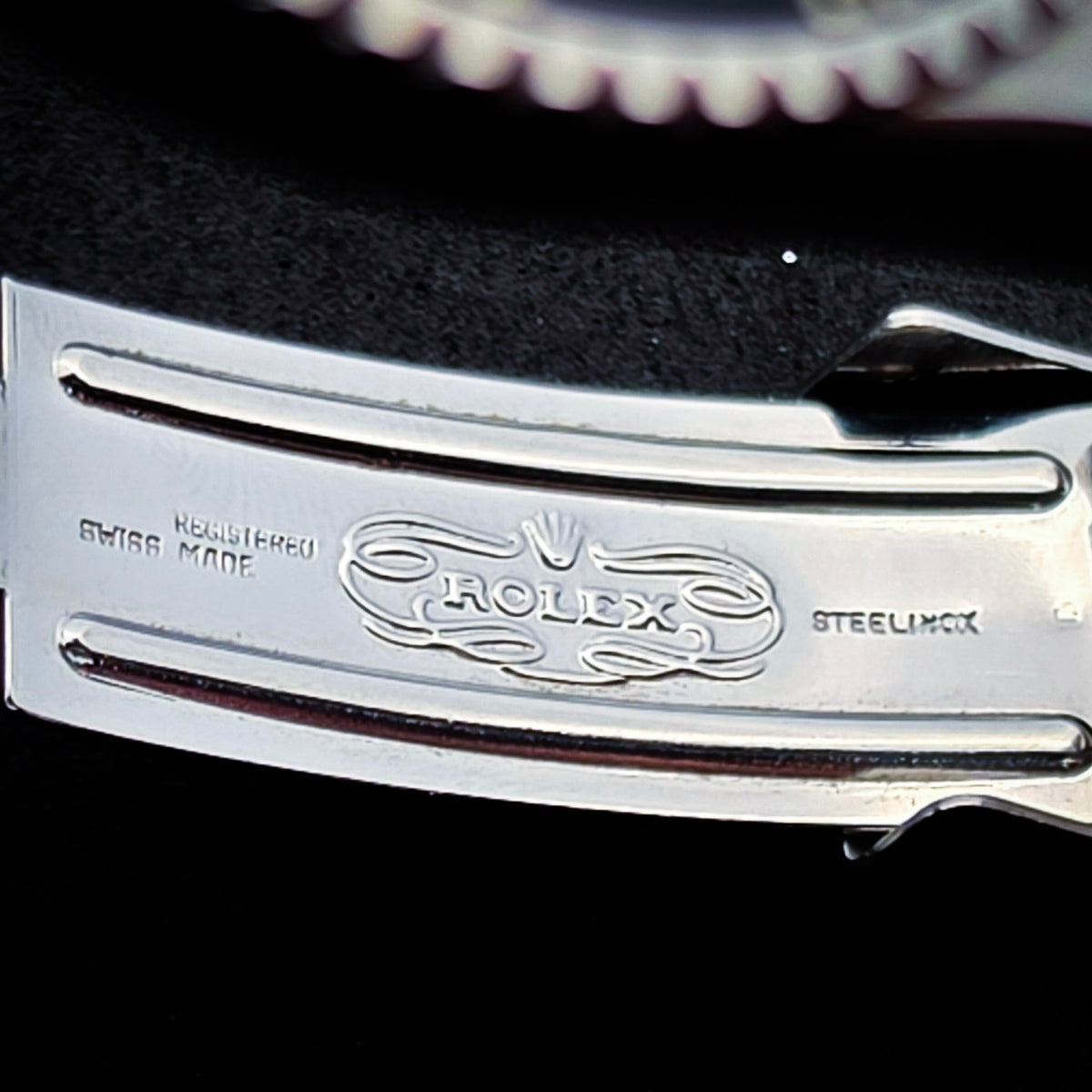
Completing the present example is a Rolex Oyster reference 9315 bracelet with 380 end links, a particularly appropriate configuration for an early 1970s Submariner Date. The reference 9315 represents an important transitional chapter in Rolex bracelet manufacturing, employing a distinctive folded-link construction before the widespread adoption of heavier solid-link Oyster bracelets. Its articulated steel links, characteristic profile and folding clasp with diver's extension reflect the functional requirements of professional underwater use.
The combination of a folded-link 9315 bracelet and 380 end links is especially appreciated by vintage Rolex enthusiasts for its period-correct appearance and historical consistency with the reference 1680. Compared with later solid-link constructions, the folded bracelet offers a lighter, more flexible presence on the wrist, preserving the delicate balance between the relatively substantial Oyster case and the understated engineering of early Rolex sports watches. Far from being a secondary accessory, the bracelet contributes significantly to the overall character and authenticity of the vintage wearing experience.
Perhaps the most important consideration when evaluating a Red Submariner is the originality of its dial. During decades of regular servicing, numerous examples received replacement components, including later white-lettered dials. Consequently, the presence of a genuine period Red Submariner dial has become a defining factor in the desirability of the reference. Dial printing, tritium plots, hands, case geometry, bezel insert, movement and bracelet should therefore be examined together rather than treated as independent details. Even the smallest characteristics can provide meaningful information about the history of an individual watch.
The Red Submariner represents an extraordinary intersection of technical evolution, design continuity and historical significance. It captures a moment when Rolex was refining the professional tool watch into something capable of transcending its original purpose, without sacrificing the essential character that had made the Submariner famous.
More than half a century after its production, the reference 1680 remains one of the most compelling expressions of vintage Rolex watchmaking. Its appeal does not depend upon precious metals, elaborate complications or decorative extravagance. Instead, it resides in the remarkable balance of its proportions, the authenticity of its professional origins and the unmistakable personality of a single red inscription.
In this circa 1972 example, the beautifully yellowed tritium hour markers, matte black dial and period-appropriate folded-link Oyster bracelet come together to create an especially charismatic interpretation of the legendary Single Red. These details tell the story of an era when Rolex watches were built primarily as instruments, long before their transformation into internationally celebrated collector's objects.
The Rolex Submariner Date Ref. 1680 “Single Red” is not simply another vintage diving watch. It is a landmark in the evolution of the Submariner, a subject of serious horological scholarship and one of the definitive references through which the history of Rolex sports watches can be understood.
Are your watches authentic?
Are your watches authentic?
Yes. Before it goes on sale, every watch is checked by our team: authentication, inspection of the movement, case and bracelet, and documentation of its condition. We guarantee the originality of all our pieces.
Is there a warranty?
Is there a warranty?
Every purchase is covered by the legal guarantee of conformity under Italian and EU law. Any lack of conformity must be reported within two months of discovering it.
How is the watch shipped?
How is the watch shipped?
Shipping is free worldwide. We use selected couriers and send you the tracking details once payment has been received. For deliveries outside Italy, import duties and taxes are paid by the buyer.
How can I pay?
How can I pay?
By credit card, bank transfer or buy-now-pay-later services where available. If you pay by bank transfer you get a 1.5% discount: contact us on WhatsApp.
Can I see the watch in person?
Can I see the watch in person?
Yes, in our shop at Via Porta Rossa 75/R in Florence, usually open from Tuesday to Saturday. Opening hours change with the season: you always find the current ones on Google Maps.
Instructions for good use of wristwatches
Legal guarantee of conformity
Download the notice as PDF


Specifics
-
General info
- Serial number: 3.17x.xxx
- Case material: Steel
- Caseback: Screw-back
- Case diameter: 40.0 mm
- Glass: Plexiglass
- Bezel Materials: Steel - Alluminium
- Dial color: Black
- Dial numerals: No numerals
- General conditions: Great conditions
- Water resistance rate: 20 ATM (not tested)
- Delivery contents: Watch only
-
Band or Strap
- Band material: Metallic bracelet
- Lug width: 20 mm
- Buckle type: Deployant
- Buckle material: Steel
-
Movement
- Calibre: Rolex 1570
- Movement type: Automatic
- Complications: Date
- Service: Last service unknown, good working order