


Rolex
Rolex GMT Master 16750 Full Set
Rolex GMT Master 16750 Full Set
Reference: 16750
Year: 1983
Couldn't load pickup availability
CHAT ON WHATSAPP
The Rolex GMT-Master ref. 16750 occupies a particularly important chapter in the evolution of Rolex’s professional watches. Introduced as the successor to the long-running ref. 1675, it retained the unmistakable 40 mm Oyster case, acrylic crystal and bidirectional 24-hour bezel of the classic GMT-Master, while bringing a significant mechanical and practical evolution through the automatic calibre 3075 and its quick-set date. Produced through the 1980s, the 16750 became the bridge between the traditional character of the vintage GMT-Master and the increasingly modern generation that followed.
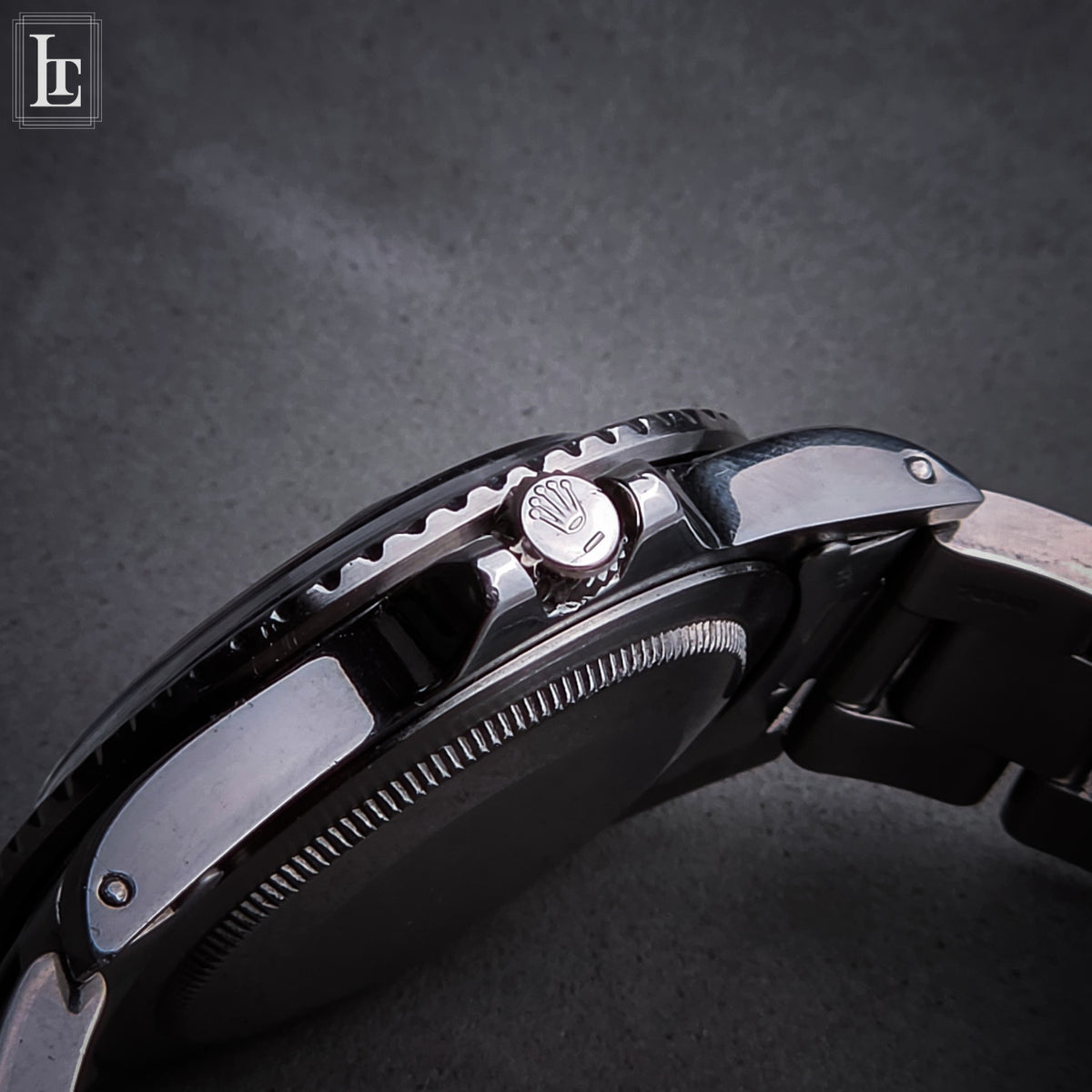
This 1983 example is particularly compelling for the collector because of the quality of preservation. The stainless-steel case retains beautifully full proportions, with substantial lugs and clearly defined case architecture—an increasingly important characteristic in vintage Rolex collecting, where excessive polishing can permanently alter the geometry of an otherwise excellent watch. The black dial is remarkably clean, while the tritium plots have developed a deep, warm and remarkably consistent patina, giving the watch the unmistakable visual character that only several decades of natural ageing can create.
The Pepsi bezel remains one of the defining signatures of the GMT-Master, but this example is accompanied by a second black bezel insert featuring the characteristic Fat Four numerals. The additional insert is an especially attractive element of the package: beyond giving the collector an alternative period appearance, it adds another layer of historical and aesthetic interest to an already exceptionally well-preserved example.
What truly distinguishes this GMT-Master, however, is the completeness of its original accompanying material. The set includes the Rolex inner box and outer box with reference sticker, Rolex hang tag, serial-number tag, original booklets, wallet, translation material, calendar and the original perforated Rolex warranty paper. Such surviving documentation and packaging are increasingly significant for vintage Rolex collectors, not simply as accessories, but as evidence of the watch’s original retail configuration and period provenance. Comparable 16750 examples described as full sets similarly place considerable emphasis on the survival of the original boxes, papers, tags and booklets.
A beautifully preserved 16750 is already a highly desirable vintage GMT-Master. Finding one from 1983 with such strong case condition, an exceptionally attractive tritium dial, an additional black Fat Four insert and this level of original documentation makes this example particularly interesting from a collector’s perspective. It is a GMT-Master that preserves not only the watch itself, but much of the physical context in which it originally left Rolex.
Are your watches authentic?
Are your watches authentic?
Yes. Before it goes on sale, every watch is checked by our team: authentication, inspection of the movement, case and bracelet, and documentation of its condition. We guarantee the originality of all our pieces.
Is there a warranty?
Is there a warranty?
Every purchase is covered by the legal guarantee of conformity under Italian and EU law. Any lack of conformity must be reported within two months of discovering it.
How is the watch shipped?
How is the watch shipped?
Shipping is free worldwide. We use selected couriers and send you the tracking details once payment has been received. For deliveries outside Italy, import duties and taxes are paid by the buyer.
How can I pay?
How can I pay?
By credit card, bank transfer or buy-now-pay-later services where available. If you pay by bank transfer you get a 1.5% discount: contact us on WhatsApp.
Can I see the watch in person?
Can I see the watch in person?
Yes, in our shop at Via Porta Rossa 75/R in Florence, usually open from Tuesday to Saturday. Opening hours change with the season: you always find the current ones on Google Maps.
Legal guarantee of conformity
Download the notice as PDF


Specifics
-
General info
- Serial number: 8.2xx.xxx
- Case material: Steel
- Caseback: Screw-back
- Case diameter: 40.0 mm
- Glass: Plexiglass
- Bezel Materials: Steel - Alluminium
- Dial color: Black
- Dial numerals: No numerals
- General conditions: Great conditions
- Water resistance rate: Not waterproof
- Delivery contents: Full set b&p
-
Band or Strap
- Band material: Metallic bracelet
- Lug width: 20 mm
- Buckle type: Deployant
- Buckle material: Steel
-
Movement
- Calibre: Rolex 3075
- Movement type: Automatic
- Complications: GMT
- Service: Last service unknown, good working order