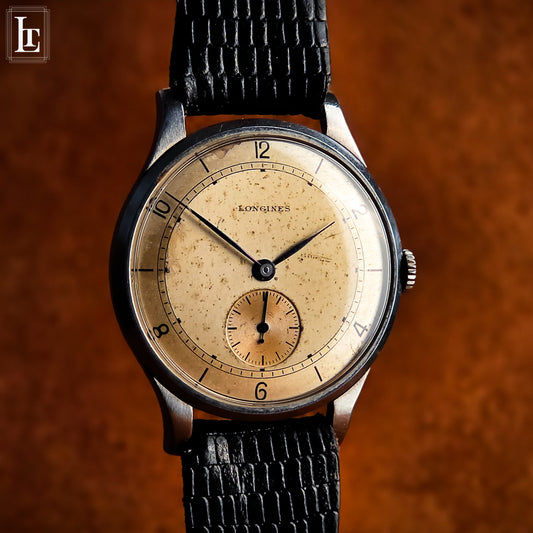


Longines
Longines 13.33 gold chronograph
Longines 13.33 gold chronograph
NOT AVAILABLE
Brand: LonginesTypology: Vintage chronograph
Year: 1927
Few wristwatches capture the spirit of interwar Swiss watchmaking quite like this extraordinary Longines monopusher chronograph from 1927. Housed in a beautifully preserved 18kt yellow gold coin case with double back, it represents the era when Longines stood at the absolute forefront of precision chronometry and chronograph development. During the 1920s, the maison was not simply producing elegant timepieces — it was dominating international observatory trials and receiving awards across Europe for accuracy, technical innovation, and movement finishing. Longines calibres from this period became benchmarks for both military and sporting chronographs, helping cement the brand’s reputation as one of the great manufactures of the early 20th century.
At the heart of this watch lies the legendary cal. 13.33, one of the earliest purpose-built wrist chronograph movements ever industrially produced. Introduced in 1913 and continuously refined through the following decades, the 13.33 is celebrated among collectors for its architecture, smooth monopusher operation, and remarkable reliability considering its age. Unlike many converted pocket watch chronographs of the period, this calibre was conceived specifically for wrist use — a revolutionary concept at the time.
The watch is further elevated by its stunning enamel dial with elegant Breguet numerals, combining technical sophistication with unmistakable classical aesthetics. The 35mm proportions remain incredibly modern on the wrist, while the warm gold case and coin-edge finishing give the piece a tactile richness impossible to reproduce today. A true museum-grade chronograph from one of Longines’ most celebrated eras.
Legal guarantee of conformity
Download the notice as PDF


Specifics
-
General info
- Serial number: 4.7xx.xxx
- Case material: Yellow Gold 18k
- Glass: Plexiglass
- Caseback: Snap-back
- Case diameter: 35.0 mm
- Bezel Materials: Gold
- Dial color: White
- Dial numerals: Arabic
- General conditions: Great conditions
- Water resistance rate: Not waterproof
- Delivery contents: Watch only
-
Band or Strap
- Band material: Lizard
- Lug width: 18 mm
- Buckle type: Classic
- Buckle material: Gold Plated
-
Movement
- Calibre: Longines 13.33
- Movement type: Manual wind
- Complications: Chronograph
Available now: Longines
-
Longines Classic Oversize
Regular price €1.900,00Regular priceUnit price per