

Franck Muller Vintage: The Story of a Modern Independent Watchmaker
Understanding the Early Years, the Franck Genève Era and Why Collectors Are Rediscovering the Brand
Today, the world of independent watchmaking is often defined by a small group of names that changed the perception of contemporary haute horlogerie. Watchmakers such as Philippe Dufour, Daniel Roth, Roger Dubuis and F.P. Journe demonstrated that a single creative vision could challenge the traditional structure of Swiss watchmaking and create something deeply personal.
Among these pioneers, however, Franck Muller occupies a particularly unique position.
Long before independent watchmaking became one of the most desirable categories among collectors, Muller had already explored a powerful idea: that a watchmaker could build a recognisable identity through the combination of technical ambition, distinctive design and uncompromising craftsmanship.
His approach was different from many of his contemporaries. Rather than simply preserving traditional watchmaking codes, he first studied them in depth — restoring and understanding some of the most important complicated watches ever created — before transforming that knowledge into something entirely his own.
This is what makes the early Franck Muller period so fascinating.
At Luxo Time Firenze, we believe that understanding the story behind a watch is essential to understanding its true importance. Some watches become significant because the market has already recognised their value. Others require a deeper level of knowledge, because their relevance is connected not only to rarity or price, but to the historical moment in which they were created.
Early Franck Muller belongs to this second category.
The perception of the brand today is complex. The evolution from a small Geneva workshop into an internationally recognised luxury company has created different opinions among collectors. For some enthusiasts, the expansion of production and the changing commercial identity of the brand have overshadowed the exceptional creativity of its formative years.
Yet the earliest Franck Muller watches represent one of the most compelling chapters in modern independent watchmaking.
They belong to a period when the relationship between creator and creation was remarkably close — when mechanical experimentation, artistic expression and artisanal execution were still directly connected to the vision of the watchmaker himself.
These watches were not created simply to follow market demand.
They were the result of a personal philosophy: the belief that traditional Swiss watchmaking could be respected while still being reinterpreted through a contemporary and unconventional perspective.
To understand why these watches are attracting renewed attention among collectors today, we must return to the beginning.
The Origins of an Independent Watchmaker

The Watchmaker Behind the Name
[IMAGE — Franck Muller during his early years as a watchmaker / restoration workbench]
Born in Switzerland in 1958 to an Italian mother and a Swiss father, Franck Muller developed a fascination for watchmaking from an early age. Long before his name became associated with expressive designs and highly complicated wristwatches, his foundation was built around something far more traditional: the patient study of mechanical watchmaking.
After graduating from the prestigious Geneva Watchmaking School, Muller quickly gained recognition among specialists for his exceptional ability as a restorer of complicated timepieces.
Unlike many contemporary watchmakers who began their careers within large manufactures, Muller’s education came from a much more intimate relationship with horological history. His knowledge was shaped not by production lines, but by direct contact with some of the most remarkable creations of traditional Swiss watchmaking.
During his restoration career, he worked on exceptional pieces including perpetual calendars, minute repeaters, tourbillons and unique complications created by some of Switzerland’s most respected maisons.
These watches were not simply objects to be repaired.
They were lessons.
Every restored movement revealed a different approach to mechanical architecture.
Every complication showed the solutions, compromises and ingenuity of the master watchmakers who created it.
Through this work, Muller developed an understanding that went far beyond the technical ability to assemble or adjust a movement. He learned how exceptional watches were conceived, finished and regulated at the highest level — understanding not only how they functioned, but why they were designed in a particular way.
This period would become the foundation of everything that followed.
It explains why the earliest Franck Muller creations feel fundamentally different from many later luxury watches.
They were not born from a commercial strategy or from the desire to follow an established market.
They came from a watchmaker whose entire philosophy had been shaped by decades of studying the greatest achievements of mechanical horology.
Before creating his own identity, Franck Muller first learned to understand the language of the masters.
The Franck Genève Era
Before Franck Muller became an internationally recognised name, there was a much smaller and more intimate chapter in the story: the period connected to Franck Genève and the early workshop production.
These watches represent the embryonic stage of the future manufacture — a moment when the brand was not yet defined by commercial success, but by the personal vision of a watchmaker and a small team working in Geneva.
For collectors today, these early pieces are among the most fascinating examples of independent watchmaking because they capture something that is increasingly rare: a direct connection between creator, workshop and final object.
Production numbers were extremely limited.
The objective was never simply to create more watches.
The objective was to create something meaningful.
Each piece reflected the philosophy of a small Geneva atelier rather than the structure of an established luxury company. Cases were crafted by specialist artisans, dials were produced with traditional techniques, and every element was finished with an attention to detail that belonged to a different era of watchmaking.
Hand-applied numerals, guilloché decoration and carefully executed finishing were not marketing elements.
They were part of the creative process.
Assembly remained closely connected to the workshop, and quality control was not separated from the person who created the watch. This proximity between maker and object is one of the reasons why these early references continue to attract experienced collectors.
In modern collecting, originality has become one of the most important factors in evaluating historical significance.
An untouched case, a correct configuration, original components and documented provenance can completely change the perception of an early independent watch.
For Franck Genève pieces, these details are not simply technical considerations.
They are part of the story.
Restoring the Great Masters
The restoration period of the 1980s is often one of the most overlooked chapters in Franck Muller’s history.
Yet, it was arguably the foundation upon which everything else was built.
Restoration is one of the most demanding disciplines in watchmaking because it requires more than technical ability. A restorer must understand the intentions of the original creator — the logic behind the mechanism, the philosophy of construction and the finishing standards that define a great movement.
Working on historical perpetual calendars, minute repeaters, tourbillons and other complicated watches gave Muller direct access to some of the highest achievements of traditional Swiss horology.
These were not simply old mechanisms.
They were the accumulated knowledge of generations of master watchmakers.
Every movement studied represented a lesson in mechanical architecture.
Every complication revealed a different solution to the challenges of precision, reliability and functionality.
Through restoration, Muller developed an understanding that went beyond repair. He learned how exceptional watches were imagined, constructed, decorated and adjusted at the highest level.
This knowledge would later become one of the defining elements of his own creations.
Rather than simply reproducing the complications of the past, Muller approached them from the perspective of an independent creator.
Traditional horology became the foundation.
Innovation became the direction.
Creating a New Identity
When Franck Muller officially launched his own manufacture in the early 1990s, the Swiss watch industry was still navigating the consequences of the Quartz Crisis.
Many traditional brands had become increasingly cautious. Design languages were often restrained, and complicated watches remained closely associated with historical forms and conservative aesthetics.
Independent watchmaking, as collectors understand it today, had not yet become a recognised and highly desirable category.
Franck Muller entered this environment with a completely different vision.
He believed that technical excellence did not need to be hidden behind traditional restraint.
A complicated watch could be expressive.
A mechanical creation could have personality.
The result was a new visual language built around several unmistakable elements:
Large curved cases.
Expressive Arabic numerals.
Complex mechanical displays.
Unexpected combinations of traditional complications and contemporary design.
The Cintrée Curvex became the symbol of this philosophy.
More than a case shape, it represented a different way of thinking about the wristwatch. Its curved architecture followed the wrist naturally, while its proportions and presence created an identity that could be recognised immediately.
The goal was never simply to create something unusual.
The goal was to create something unmistakable.
That achievement would influence an entire generation of independent watchmakers and luxury brands that followed.
The Philosophy Behind Early Production
One of the most misunderstood aspects of early Franck Muller watches is the level of craftsmanship behind their creation.
The first years were not defined by volume.
They were defined by refinement.
Cases received extensive finishing.
Dials demonstrated exceptional depth and precision.
Movements were carefully modified, decorated and adjusted before reaching collectors.
A common misconception in modern collecting is that a watch’s importance depends exclusively on whether it contains a completely in-house movement.
History tells a more complex story.
Many of Switzerland’s most respected maisons built their reputation by taking exceptional mechanical foundations and transforming them through expertise, finishing and technical development.
The identity of a watch has never depended only on where a movement begins.
It depends on what the watchmaker achieves afterwards.
Franck Muller followed this traditional Swiss philosophy: taking established mechanical architectures and transforming them into distinctive expressions of independent watchmaking.
The value of these early creations lies not only in their components.
It lies in the vision that brought those components together.
The Golden Era (1992–2010)

The Years That Defined Franck Muller
The 1980s established Franck Muller as one of Switzerland’s most respected specialists in the restoration of complicated timepieces. The following two decades, however, transformed him from a highly regarded watchmaker into one of the most distinctive independent voices of modern horology.
Between approximately 1992 and 2010, the manufacture entered what many collectors now consider its defining period — a moment when creativity, technical ambition and craftsmanship existed in a rare state of balance.
It was a time when Franck Muller represented the meeting point between three different worlds:
The creativity of an independent atelier.
The ambition of a high complication manufacture.
The tradition of Geneva watchmaking.
Unlike many brands that achieved growth by moving toward simplification and standardisation, early Franck Muller followed a different path.
The focus was not on producing more.
It was on creating more.
Complexity became part of the identity of the manufacture. Cases evolved with increasingly sophisticated shapes and finishing, dials became a canvas for depth, colour and visual expression, and complications were not treated as historical exercises but as opportunities to explore new ideas.
Every element of the watch became part of a larger creative language.
The movements themselves reflected this philosophy. Rather than simply serving as mechanical engines hidden beneath the dial, they were carefully developed, modified, decorated and adjusted to become part of the overall personality of the watch.
This period represents the moment when Franck Muller achieved something particularly rare in modern watchmaking: the ability to combine technical seriousness with an unmistakable aesthetic identity.
For collectors today, these years remain the reference point against which the brand’s history is often measured — a chapter where the vision of the founder was still deeply connected to every creation.
Watchland: Building an Independent Manufacture

The creation of Watchland in Genthod, near Geneva, represented one of the most ambitious projects undertaken by an independent watchmaker during the 1990s.
At a time when many independent creators were still operating through small workshops and relying on external specialists, Franck Muller pursued a different vision: creating an environment where the different disciplines required to produce complicated watches could exist within a closer and more controlled structure.
The objective was clear.
Not simply to increase production, but to protect the creative process.
Watchland was not conceived as an assembly facility.
It represented a philosophy.
The idea was to bring together the essential elements of high-level watchmaking — case construction, movement decoration, assembly, regulation, research and development, and quality control — within a single environment where each stage could remain connected to the original vision of the manufacture.
This approach was particularly significant for an independent brand.
Control over these different disciplines allowed Franck Muller to maintain a distinctive identity while continuing to develop increasingly ambitious complications and designs.
The result was a level of coherence that collectors still appreciate today.
A watch created during this period often reveals a clear relationship between every element: the architecture of the case, the character of the dial and the refinement of the movement all appear to belong to the same creative idea.
For collectors, this connection is one of the defining characteristics of the golden era.
It represents a moment when independent ambition and artisanal execution existed together, before the challenges of larger-scale production began to reshape the relationship between creator and manufacture.
The Cintrée Curvex: A Modern Icon

Few watch cases introduced during the modern era achieved the immediate recognition and lasting influence of the Cintrée Curvex.
Its importance, however, goes far beyond aesthetics.
When Franck Muller introduced this distinctive case design, he was not simply creating a new shape. He was challenging the traditional idea that a complicated watch needed to follow conservative proportions and familiar forms.
The Cintrée Curvex represented a new interpretation of the relationship between a watch and the wrist.
Its elongated profile was designed to follow the natural curvature of the wearer, creating a presence that was both elegant and unconventional. Behind its apparent simplicity, however, was an extraordinary level of technical complexity.
The geometry of the case required advanced manufacturing precision, while the transitions between polished surfaces demanded exceptional finishing skills.
The stepped bezel added another layer of depth, interacting with light in a way that made the case appear constantly changing depending on the angle of observation.
Unlike a conventional tonneau case, the Cintrée Curvex could not be reduced to a simple industrial shape.
Its identity depended on proportion, finishing and balance.
Every curve, every transition and every polished surface had to work together in perfect harmony.
This is one of the reasons why early examples from the 1990s continue to attract the attention of experienced collectors.
When preserved in original condition, these watches reveal the sharp architecture and refined finishing that defined the golden era of Franck Muller.
An untouched example does not simply show a well-preserved case.
It preserves the original intention of the designer — the moment when a new visual language was created and became one of the most recognisable signatures of independent watchmaking.
The Forgotten Art of Dial Making

Movements: Tradition, Modification and Expertise

The Complication Philosophy

Finishing Standards

Examining an early Franck Muller under magnification reveals a level of attention to detail that is often underestimated.
At first glance, these watches are immediately recognisable for their bold design and distinctive presence. Yet, for experienced collectors, the true appreciation often begins when looking closer — beyond the first impression and into the details of execution.
Sharp bevels.
Clean polishing.
Consistent brushing.
Detailed movement decoration.
Hand-finished components.
Carefully executed transitions between surfaces.
These elements share one essential requirement:
Time.
And in traditional watchmaking, time is the foundation of craftsmanship.
During the golden era, production volumes allowed Franck Muller to maintain a closer relationship between creation and finishing. Each component passed through a process where technical execution and aesthetic refinement remained deeply connected.
As the company expanded and the catalogue grew, maintaining the same level of manual intervention across a wider range of watches naturally became a greater challenge.
This evolution does not mean that later Franck Muller watches lack quality.
Rather, experienced collectors often look back to the early period because it represents a particularly rare balance:
The creativity of an independent watchmaker combined with the execution of a highly skilled Geneva atelier.
This is what gives the watches from this era their particular character.
They are not only examples of complicated horology.
They are objects created during a moment when ambition, craftsmanship and personal vision existed in perfect harmony.
The Peak Years: When Vision and Execution Reached Balance
Many collectors identify the late 1990s and early 2000s as the moment when Franck Muller reached its strongest equilibrium.
By this stage, the foundations created during the previous decade had fully matured. Watchland had developed into a true independent manufacturing environment, production capabilities had expanded, and the technical expertise required to create increasingly complex watches had reached a remarkable level.
Case construction achieved exceptional consistency.
Dial production demonstrated extraordinary sophistication.
Complication development became one of the central expressions of the manufacture’s identity.
Yet, despite this growth, something remained unchanged:
The personality of the founder was still clearly visible in every creation.
This balance was what made the period particularly significant.
Franck Muller had achieved something difficult to replicate — the ability to grow as a manufacture while maintaining the creative character of an independent watchmaker.
Whether looking at a simpler automatic reference or one of the brand’s most technically ambitious creations, the underlying philosophy remained consistent:
A distinctive design language supported by genuine horological substance.
These watches were not created simply to follow market trends.
They represented a specific moment in modern watchmaking, when technical ambition and personal expression existed together.
Why 2010 Represents a Turning Point
Around the end of the 2000s and the beginning of the following decade, Franck Muller entered a new chapter.
The brand had achieved international recognition, its presence around the world had grown significantly, and the catalogue expanded to reach a broader audience.
This evolution brought undeniable success.
However, it also changed the relationship between the brand and many collectors.
As production increased and the range of models became wider, the perception of Franck Muller naturally began to evolve. For enthusiasts who had followed the company from its independent origins, the earlier period represented something increasingly unique: a moment when the connection between founder, workshop and watch was exceptionally direct.
It is important to emphasise that quality did not disappear after 2010.
Many modern Franck Muller watches continue to demonstrate impressive technical ability, strong design identity and excellent execution.
However, among experienced collectors, the earlier period maintains a special position because it represents the moment when the brand’s three defining elements were most closely connected:
Independent origins.
Founder-driven creativity.
Artisanal execution.
This distinction is becoming increasingly recognised in the secondary market, where early examples in original condition are attracting renewed attention from collectors searching for historical significance rather than simply contemporary visibility.
The appeal of early Franck Muller lies not only in what these watches are, but in what they represent: a moment when an independent watchmaker was redefining the possibilities of modern Swiss horology.
7000 CC: The Foundation

The 7000 CC represents one of the purest expressions of the round automatic chronograph created during the golden era of Franck Muller.
Its importance comes from balance.
Unlike some of the more complex references that defined the technical ambition of the manufacture, the 7000 CC achieves something equally difficult: it combines sophistication with clarity.
It is technically accomplished without unnecessary complexity.
It is immediately recognisable without relying exclusively on the dramatic presence of the Cintrée Curvex case.
The round architecture creates a different type of appeal. Without the visual impact of the curved case, attention naturally moves toward the elements that define the personality of the watch: the proportions of the dial, the expressive numerals, the finishing and the harmony between traditional chronograph design and Franck Muller’s unmistakable aesthetic language.
The 7000 CC demonstrates an important aspect of the brand’s identity.
Franck Muller was not only a creator of unconventional shapes and spectacular complications.
He was also capable of creating a serious independent chronograph while respecting the classical proportions and elegance of Geneva watchmaking.
It represents the moment where tradition and individuality meet.
The 7000 Family: The Complicated Side of Franck Muller
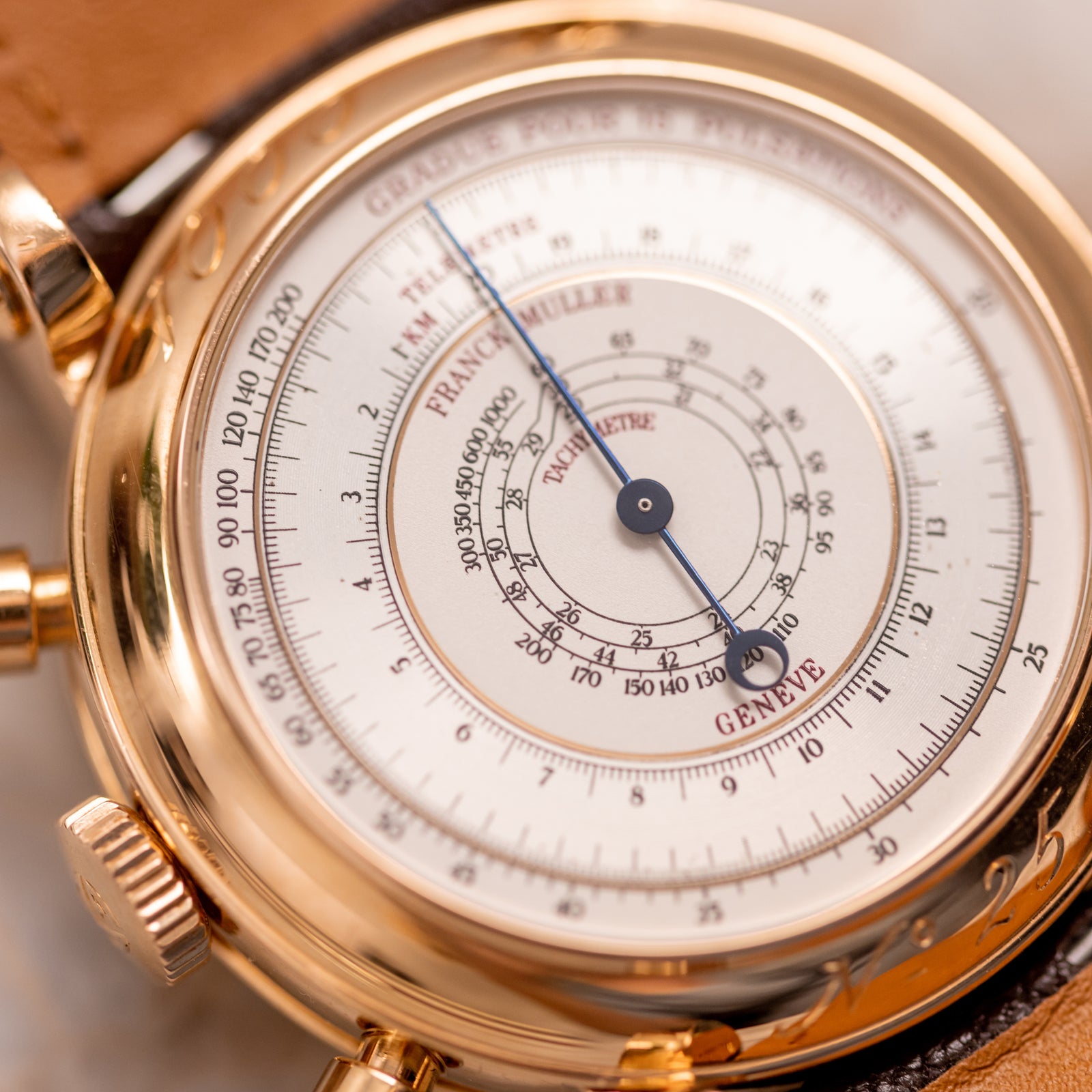
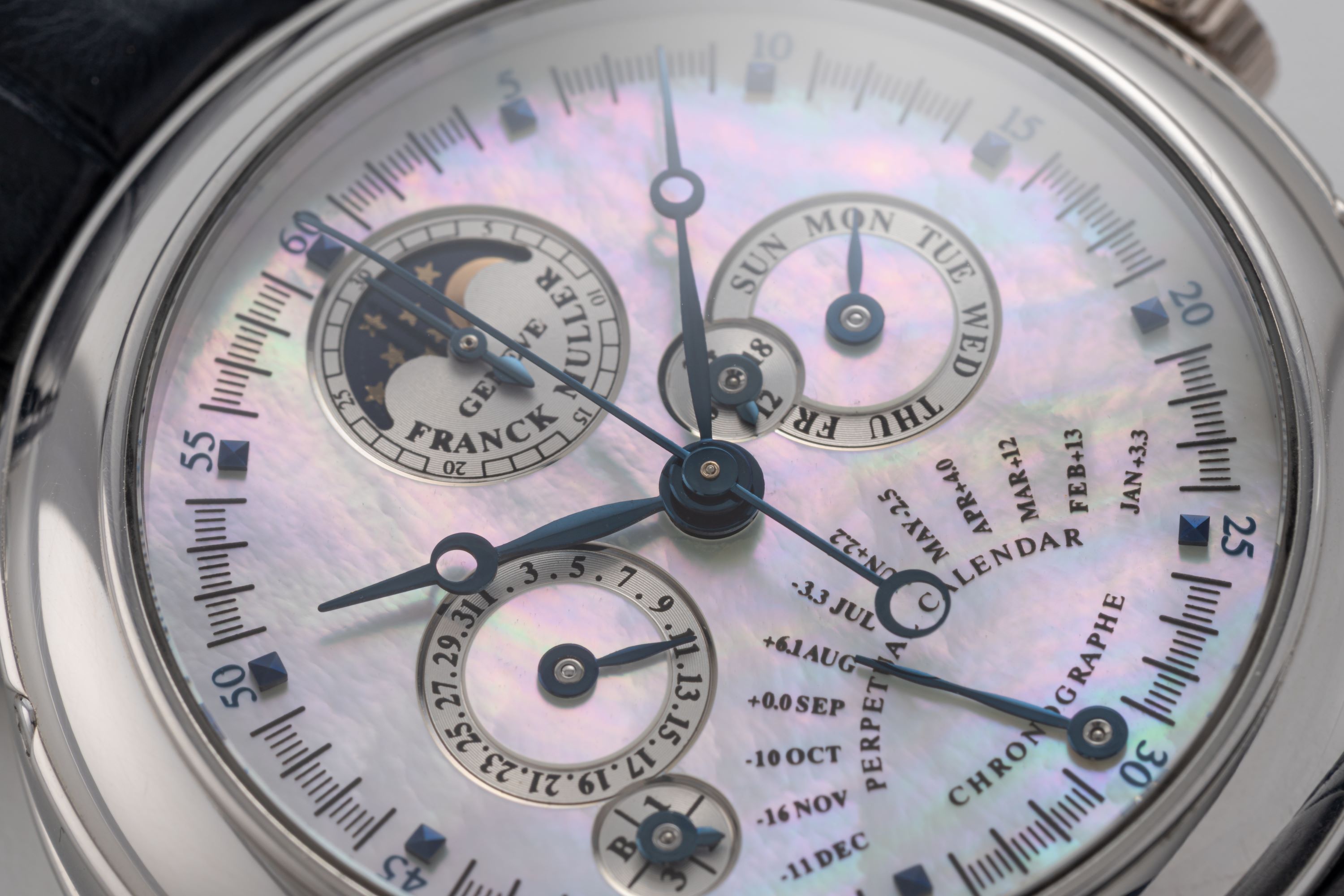
The true importance of the 7000 family becomes even clearer when examining the more complex variations created during the golden era.
These references reveal a different side of Franck Muller — one focused not only on design identity, but also on technical ambition and the exploration of modern complications.
They demonstrate the vision of a young independent manufacture that was not simply creating visually distinctive watches, but actively contributing to the evolution of contemporary haute horlogerie.
The 7000 family occupies a fascinating position within the brand’s history because it combines two worlds:
The recognisable design language of Franck Muller.
The traditional seriousness of complicated Swiss watchmaking.
For collectors, these watches represent a particularly rewarding field of study.
They are not references that reveal their full importance at first glance.
They require context.
They require knowledge.
And this is precisely what makes them interesting.
The more one understands the period, the philosophy and the craftsmanship behind these watches, the more their significance becomes evident.
The 7000 family is not simply a collection of complicated timepieces.
It is a document of a moment when Franck Muller was defining what an independent manufacture could become.



The Collector’s Perspective: Looking Beyond the Market
The history of independent watchmaking has often followed a fascinating pattern.
First comes recognition of the creator.
Then collectors begin to understand the importance of the earliest and most significant periods.
Finally, the market starts to distinguish between ordinary production and watches that represent a meaningful moment in horological history.
This evolution can be observed across several independent watchmakers who were initially appreciated by a small group of enthusiasts before receiving broader recognition from the collecting community.
However, Franck Muller follows his own path.
His story should not simply be compared to that of other independent creators. Every watchmaker develops within a unique historical context, and every brand follows a different trajectory.
Yet, the principles of collecting remain remarkably similar.
The most important watches are not always those with the greatest visibility.
They are often the watches created during the period when the founder’s vision was strongest.
Early complicated Franck Muller references represent precisely this moment.
They are not simply vintage watches.
They are historical documents from a period when one watchmaker challenged traditional ideas about what independent Swiss watchmaking could become.
They capture a moment of experimentation, ambition and creativity — a time when the boundaries between traditional haute horlogerie and modern independent design were being redefined.
Why Collectors Are Paying Attention Again
The current collector landscape is increasingly moving away from purely trend-driven choices.
After years in which market visibility and popularity often influenced collecting decisions, many enthusiasts are returning to a more fundamental approach:
Understanding the story behind the watch.
Long-term appreciation is often connected not only to rarity, but to historical context.
The watches that become truly significant are usually those connected to:
A visionary creator.
An important technical achievement.
A distinctive design language.
A limited and meaningful production period.
A defining moment in horological history.
Early Franck Muller satisfies many of these characteristics.
This does not mean that every vintage reference will achieve the same level of recognition.
Collecting requires knowledge, careful research and a disciplined evaluation of condition and originality.
The difference between an interesting example and an exceptional collector piece often lies in the details:
Original finishing.
Correct configuration.
Provenance.
Condition.
Historical relevance.
For this reason, the most important early Franck Muller watches deserve to be studied individually rather than judged only through general market perception.
History is rarely written by averages.
It is written by exceptional examples.
Beyond the Market: Final Thoughts

If one conclusion emerges from studying the history of Franck Muller, it is that the brand deserves to be understood before being judged.
The modern collector market moves quickly. Trends, auction results and public perception can influence how watches are viewed, sometimes overshadowing pieces whose importance is rooted in history rather than speculation.
Franck Muller represents a particularly interesting example of this phenomenon.
The brand expanded the possibilities of independent watchmaking by combining technical ambition, unconventional design and a willingness to challenge established conventions.
Not every reference carries the same historical importance.
Not every production period represents the same creative moment.
However, overlooking the early years means overlooking a significant chapter in the evolution of contemporary Swiss watchmaking.
From the Franck Genève period to the golden era of Watchland, the early complicated references reveal the vision of a watchmaker who wanted to create something recognisable, technically meaningful and emotionally engaging.
For collectors willing to look beyond the most obvious names, early Franck Muller represents an opportunity to rediscover a remarkable moment in horological history.
At Luxo Time Firenze, we believe that the most fascinating watches are those where craftsmanship, history and personal vision meet.
Because ultimately, collecting is not only about owning a valuable object.
It is about understanding why that object exists, why it mattered when it was created, and why decades later it continues to inspire passion among collectors.
Francesco Lo Rocco
Luxo Time Firenze
Discover our selection of historically significant vintage watches or contact Luxo Time Firenze for private collector enquiries.